Why Electricians in Kent and the South Puget Sound Don't Show Up on Google (and How to Fix It)
If your electrical company is missing from Google when nearby customers need help, the problem may not be your workmanship. It may be that Google, and potential customers, can’t quickly tell what you do, which communities you serve, or why they should choose you.
That matters across the South Puget Sound. Customers may search for an electrician in Kent, Auburn, Tacoma, Puyallup, Lakewood, or another community in your service area. As an owner or contractor running a service-area business, you work across multiple communities rather than from a single storefront, so your online presence needs to show both Google and customers exactly where you take jobs, not just where your business is based.
At JLT Web Design & Digital Marketing, our core message is: “We help local trade businesses get found and chosen online, and we prove it by ranking #1 in Kent ourselves,” backed by 58 five-star reviews and our #1 Kent ranking for web design/SEO.
Why local search can turn into real calls
The intent behind a nearby search is urgent: a homeowner with a tripping breaker or a business owner planning a panel upgrade wants a qualified electrician, not a long research project.
Recent US consumer research backs that up. BrightLocal’s 2025 consumer search study found 46% of consumers always or often add “near me” when searching for a local business. HubSpot’s 2025 local SEO research reports that 88% of people who search for a local business on a smartphone visit or call within 24 hours, and 28% of local searches result in a purchase within a day. Yelp’s 2025 study of high-intent consumers found 57% of users contact a local business within a day of searching, and 82% hire or buy within a week. These figures describe local searchers across industries, not electricians specifically, so read them as a strong signal of how nearby customers behave. (BrightLocal consumer search research; HubSpot local SEO stats; Yelp high-intent study)
Fix 1: Make your Google Business Profile complete and accurate
Start with your Google Business Profile. Check that your business name, phone number, website, hours, primary category, services, and service-area settings are accurate and up to date. Use the category that best describes your actual business, and add other categories only when they genuinely apply.
Google says customers are 70% more likely to visit and 50% more likely to consider purchasing from businesses with complete profiles. These are customer-behavior findings, not a guarantee of higher rankings. Google’s guidance says local results are mainly based on relevance, distance, and prominence; businesses can’t pay for a better organic local ranking. (Google on completing your profile; Google’s local ranking guidance)
If customers don’t visit your business address, set up the profile as a service-area business and follow Google’s rules for showing or hiding your address. List the communities you genuinely serve. Don’t create extra profiles for cities where you don’t have eligible business locations, or add city names to your business name when they aren’t part of its real-world name.

Quick profile check
- Is “Electrician” the most accurate primary category?
- Are your listed hours correct, including emergency or after-hours availability?
- Do your services describe the work you actually offer?
- Can a customer tap to call, visit your website, or request an estimate?
- Are your service areas accurate and realistic?
- Do your photos show your team, vehicles, equipment, and completed work?
A reported 2024 Google Business Profile study found about 84% of profile views came from discovery searches: searches for a service or category, rather than a business by name. Birdeye reported this statistic, so treat it as a secondary-source benchmark, not an official Google ranking factor. The practical takeaway: your profile should explain what you do clearly to people who have never heard of your company. (Birdeye’s report on profile analytics)
Fix 2: Build useful service pages, not a stack of copied city pages
Your website needs to answer the questions a potential customer has before calling: Do you handle panel upgrades? EV charger installation? Troubleshooting? What areas do you cover? Are you licensed and insured? How can someone get a quote?
Create a clear page for each major service you actually provide. Then explain your South Puget Sound coverage in a useful, honest way. A page about electrical services in Tacoma should offer real information for Tacoma customers, not just repeat your Kent page with a different city name. Include locally relevant project examples, if available, and explain which communities you serve.
Avoid publishing a batch of thin pages that swap “Kent” for “Auburn” or “Puyallup.” Pages with little unique value can frustrate customers and do little to establish genuine relevance. A smaller set of helpful pages is stronger than a larger set of near-duplicates.
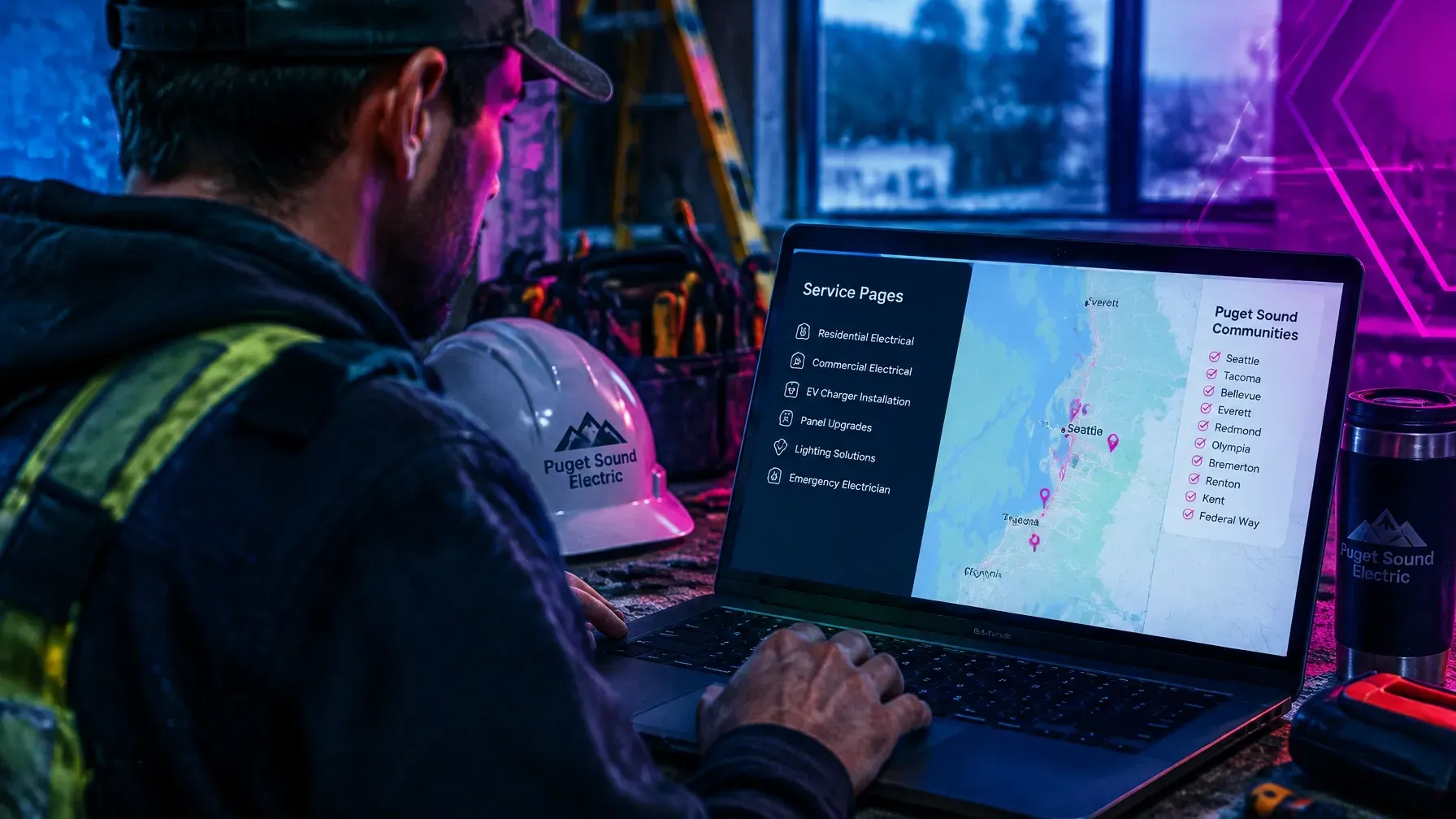
Make every page easy to use on a phone. Put the most useful details near the top: your service, service area, phone number, and a clear way to request an estimate. Fast, frictionless design helps a visitor move from a search to a conversation without hunting through menus.
Fix 3: Earn trust with real reviews and project proof
Reviews help customers decide whether to call. Ask every customer for an honest review after the work is complete, using Google’s review link. Never offer incentives or pressure customers to leave a specific rating. Respond professionally to positive and negative feedback, and keep the focus on resolving the customer’s concern.
Your website can reinforce that trust with real project photos and short case examples. Explain the work performed, the type of property, and the community, only when the customer has approved sharing those details. Specific proof is more useful than generic claims like “best electrician in the area.”
Fix 4: Measure booked opportunities, not just rankings
A rank check from your shop or home doesn’t tell you what a customer sees across the whole region. Google’s distance factor means local results can vary depending on where the search happens. Track visibility from representative locations, but connect those observations to business outcomes.
Monitor calls, estimate requests, qualified leads, and booked jobs. Review your Google Business Profile performance and website analytics to learn which searches and pages are contributing to inquiries. If a page gets visits but few calls, improve the page’s clarity and contact options. If customers call but don’t book, the issue may be elsewhere in your sales process.
A practical 30-minute visibility audit
- Search Google for your business name. Confirm your phone, hours, website, and service details are correct.
- Search for a core service plus a city you genuinely serve. Note what local businesses appear, but remember results vary by location.
- Open your website on a phone. Can a customer understand your services and tap to call without scrolling through irrelevant content?
- Review your service pages. Do they give specific, useful answers, or repeat generic copy?
- Check your latest reviews and your responses. Is it easy for a satisfied customer to leave feedback?
- Record where inquiries came from. A simple lead log can reveal which sources bring actual opportunities.
Turn local visibility into a stronger pipeline
If your electrical business is hard to find online, you don’t need another vague promise. You need a clear profile, useful service information, credible proof, and a way to measure whether that visibility becomes real inquiries.
Start with the fixes you can verify: complete your profile, make your service area accurate, strengthen your key service pages, and make calling or requesting an estimate easy. Then measure what changes. That’s how you move from invisible to easier to find, and from a passive website to a more effective tool for winning work.
If you'd rather have a professional handle it, start with JLT's free 15-minute consultation. Fifteen minutes on the phone with our team, no obligation, and you'll leave with a clear idea of what's holding your local visibility back.
About JLT Web Design & Digital Marketing
Founded by Jeff Thungc in Kent, Washington, JLT helps small businesses with web design, local SEO, social media content, and business listings. Our virtual team provides practical support for building and maintaining your online presence.
Meet Jeff Thungc, our founder | Learn about JLT
Book a free 15-minute discovery call
Share this article
Checkout More of Our Blog Posts